Part A – Carbon atoms in acetyl CoA formation and the citric acid cycle
Part A – Carbon atoms in acetyl CoA formation and the citric acid cycle
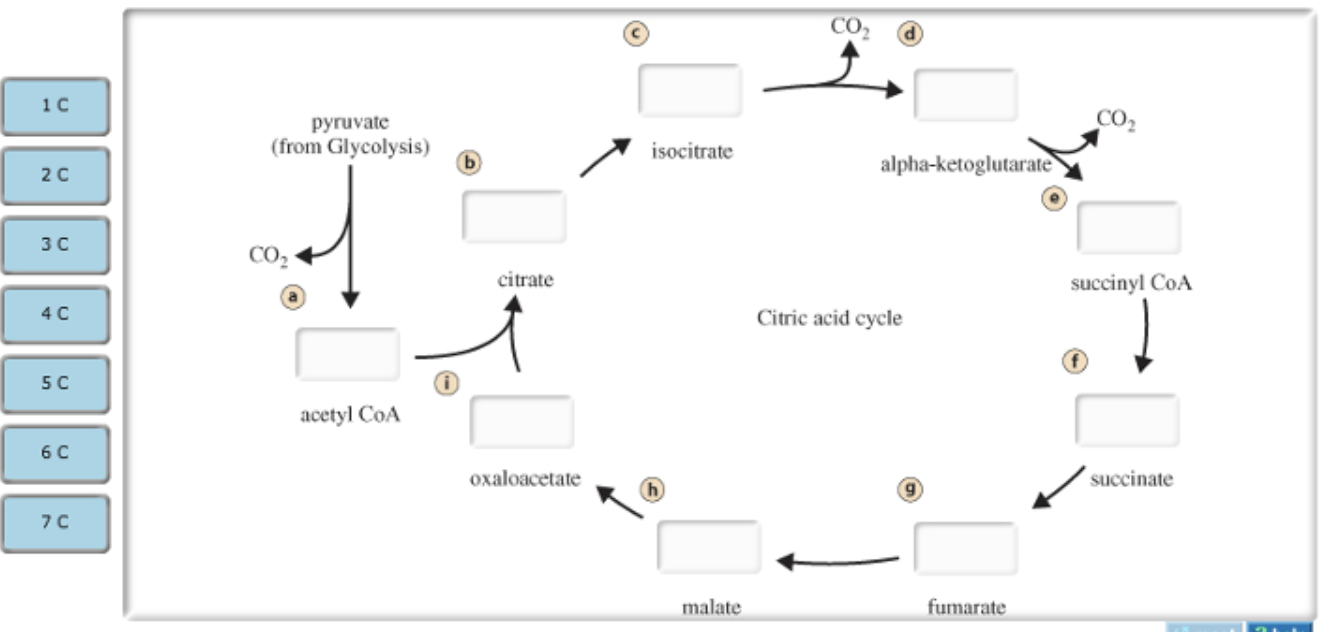
During acetyl CoA formation and the citric acid cycle, all of the carbon atoms that enter cellular respiration in the glucose molecule are released in the form of CO2. Use this diagram to track the carbon-containing compounds that play a role in these two stages.
Drag the labels from the left (which represent numbers of carbon atoms) onto the diagram to identify the number of carbon atoms in each intermediate in acetyl CoA formation and the citric acid cycle. Labels may be used more than once.
Part B – Net redox reaction in acetyl CoA formation and the citric acid cycle
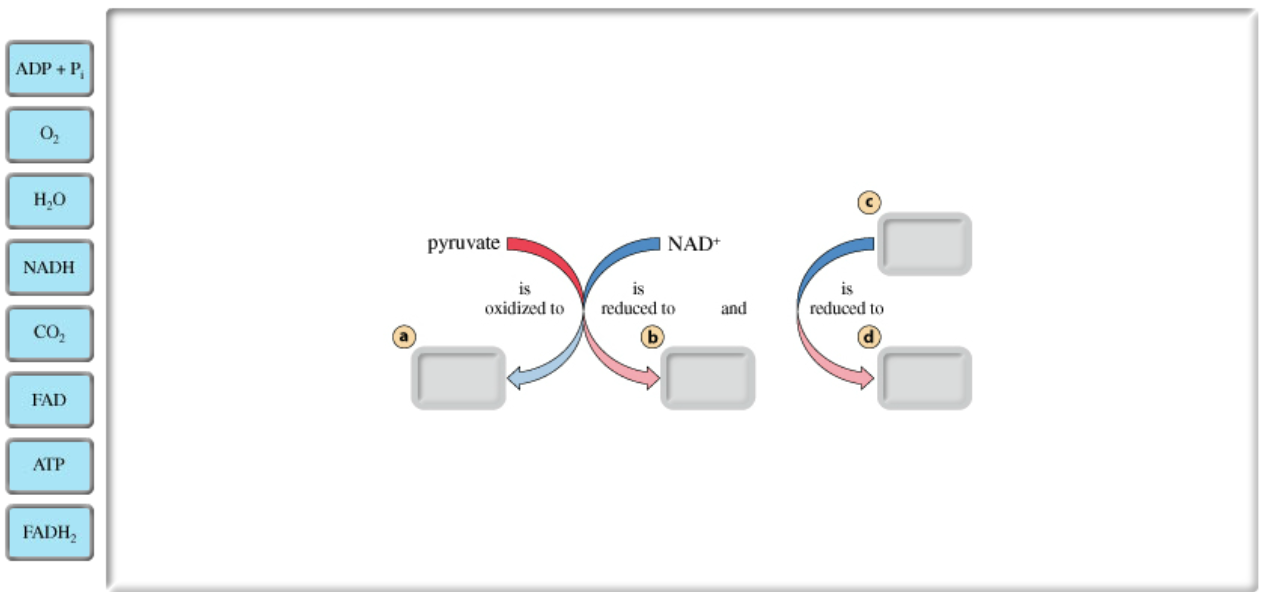
In the sequential reactions of acetyl CoA formation and the citric acid cycle, pyruvate (the output from glycolysis) is completely oxidized, and the electrons produced from this oxidation are passed on to two types of electron acceptors.
Drag the labels on the left to show the net redox reaction in acetyl CoA formation and the citric acid cycle. Note that two types of electron carriers are involved.
Part C – Why is the citric acid cycle a cyclic pathway rather than a linear pathway?
In the oxidation of pyruvate to acetyl CoA, one carbon atom is released as \mathrm{CO}_{2}. However, the oxidation of the remaining two carbon atoms-in acetate- -to \mathrm{CO}_{2}, requires a complex, eight-step pathway-the citric acid cycle. Consider four possible explanations for why the last two carbons in acetate are converted to \mathrm{CO}_{2} in a complex cyclic pathway rather than through a simple, linear reaction.
- Use your knowledge of the first three stages of cellular respiration to determine which explanation is correct.
- More ATP is produced per \mathrm{CO}_{2}, released in cyclic processes than in linear processes.
- It is easier to remove electrons and produce \mathrm{CO}_{2} from compounds with three or more carbon atoms than from a two-carbon compound such as acetyl CoA.
- Redox reactions that simultaneously produce \mathrm{CO}_{2} and NADH occur only in cyclic processes.
- Cyclic processes, such as the citric acid cycle, require a different mechanism of ATP synthesis than linear processes, such as glycolysis.